Angelenos watch the sky with a new kind of attention. A winter of atmospheric rivers can follow a string of dry years. Lawns that never puddled now keep water for days. Driveways pitch runoff toward garage doors. On a hillside, a poorly shaped swale becomes a gully, then a lawsuit. Good drainage is not a luxury in Los Angeles. It is what protects foundations, hardscapes, and the landscape investments that give a backyard its purpose.
At Ridgeline Outdoor Living, we design and build outdoor spaces all over the basin, the foothills, and the coast. French drains and thoughtful grading sit at the core of almost every successful project. The right details vary by lot and soil, but the principles hold. Water moves by gravity. It follows the easiest path. If you do not choose that path with intention, water will choose it for you.
What makes LA drainage different
Southern California lulls people into thinking drainage is simple. The yearly rainfall averages look modest. The catch lies in intensity. A single storm can drop inches in a day, then nothing for weeks. Soil hardens between storms, so infiltration is lower when you need it most. Clay pockets in the Valley behave like bathtubs. Coastal sand percolates fast, then saturates near a high water table. Hillsides shed water quickly, magnifying the force that hits the toe of a slope. And many neighborhoods predate current stormwater management standards. Downspouts dump to planters that sit above hardscape. Driveways tilt toward the house because that was how it fit the day it was poured.
City rules also matter. Los Angeles wants stormwater kept on site where practical, both to reduce burden on the system and to recharge aquifers. Direct connections to the sanitary sewer are prohibited. Curb cores and storm drain tie-ins require permits and, in many cases, pretreatment or filtration for first flush water. These pieces shape design options as much as the property does.
Reading a yard for water
Before we trench or grade, we read the yard. That starts with elevation points and a level, but it also uses observation. Where does silt collect after a storm? Are there salt crusts on the edge of concrete where evaporation leaves minerals behind? Does turf thin in a stripe that matches an old pipe we cannot see? Is there moss or efflorescence on one side of the stem wall? On hillsides, any hairline cracking on a retaining wall, a fence that leans a degree more than it should, a planter that slumps at a corner are clues to long-term water patterns.
We ask about flooding history, but we do not rely only on memory. In one Brentwood job, the owner swore the driveway never puddled. We pulled satellite images from the prior winter and showed a dark ribbon along the garage threshold in two storms. The fix was not a single trench. It was a new longitudinal grade on the drive, a trench drain at the threshold, and a French drain behind the planter that had been acting like a dam.
The anatomy of a proper French drain
A French drain is not just a pipe in a trench. When it works, it mimics a groundwater interceptor and a conveyance line at once. Its simplicity hides the fact that proportions and materials matter.
We typically use a 4 inch perforated SDR-35 or Schedule 40 pipe for residential work. On long runs that collect from large areas, 6 inch pipe may make sense to maintain velocity without surcharging. Pipe sits in a trench lined with nonwoven geotextile. We set the pipe at a continuous slope, usually 1 to 2 percent. Less than 1 percent works on stable subgrades with consistent bedding, but we prefer more when space allows. In tricky, short runs, we will accept 0.5 percent with carefully compacted bedding and cleanout access.
The gravel envelope is not decoration. Angular 3/4 inch clean crushed rock provides void space and resists migration. We do not use pea gravel. Depth depends on goals. If we are primarily catching roof leader overflows and surface water, a 6 to 8 inch layer below and 6 to 8 inches above the pipe is typical, with more stone at the upslope side to invite infiltration. If we are intercepting perched water along a slope or footing, we may go 12 to 18 inches below the pipe to create more storage volume and a longer pick-up face. We then wrap the stone in the geotextile to separate it from fines. Backfill to grade with native soil or topsoil, or cap with turf, mulch, or decorative gravel.
Infiltration or discharge depends on site and regulation. If percolation rates are good and setbacks allow, we favor infiltration along the run, with overflow to a safe discharge point such as a pop-up emitter at a low lawn or a permitted curb core. In slow soils, we collect and convey with minimal infiltration to avoid building a soggy sponge. On flat lots with no good outlet, a sump and pump is Plan B. We avoid pumps when gravity can do the job. Pumps need power, maintenance, and backup or bypass planning.
Cleanouts every 50 to 75 feet help jet the line if silt creeps in over time. Catch basins with filters at inlets keep leaf litter out of the system. We keep French drains at least 3 to 5 feet off foundations unless the goal is deliberate subdrainage with proper waterproofing in place. Even then, we do not undercut footings. If we need to lower groundwater near a structure, we coordinate with the builder and engineer. There is a careful balance between protecting a wall and drying a clay soil so much it shrinks and compromises support.
Grading as the first line of defense
Grading remains the most cost-effective drainage tool. Shape the surface to move water predictably, and you reduce the load on every pipe. For lawns and planters, we aim for 2 percent fall away from the house for the first 5 to 10 feet where space allows. On patios, 1 to 1.5 percent keeps water moving without feeling tilted underfoot. Narrow walks are comfortable at 1.5 to 2 percent. Driveways vary with material and layout, but 1 percent is the minimum we accept if there is any chance of wind-driven rain or leaf fall that could slow flow.
Swales carry water where slopes and setbacks do not allow straight shot grades. A properly shaped turf swale can move surprising volumes without looking like a ditch. The key is smoothness. A swale needs a consistent cross slope, a clean path, and no flat spots. We often blend swales into planting beds where mulch and root systems tolerate periodic wetting. On hillsides, we use shallow, wide swales above walls to intercept sheet flow, then discharge at a controlled point into an energy dissipation feature or a downstream drain.
Grade ties matter as much as slopes. A patio that sheds perfectly at 1 percent into a planter that sits an inch too high will trap water. We avoid creating bathtubs by stepping planters down with site fall, keeping edging and mow strips low on the downslope side, and giving every low spot a deliberate exit.
Soil, percolation, and what they mean for design
LA County soils range widely in texture and behavior. Valley clays swell when they get wet, then shrink as they dry. Decomposed granite drains well but slumps if saturated on a steep face. Imported fill on older lots can be a blend of fines and construction debris. We test when the clues point to trouble. A simple jar test and a hose-soak observation gives us a first read. For larger systems or hillside work, a percolation test is money well spent. Roughly speaking, percolation faster than 1 inch per hour supports infiltration trenches and dry wells. Between 0.25 and 1 inch per hour may call for hybrid systems with limited infiltration plus conveyance. Below 0.25 inch per hour, infiltration can create chronic wet zones unless the storage volume is generous and the tributary area is small.
Business Name: Ridgeline Outdoor Living
Address: 845 E Walnut St, Pasadena, CA 91101, United States
Phone: (626) 469-5822
Ridgeline Outdoor Living
Ridgeline Outdoor Living is a Pasadena-based landscape design-build company serving Greater Los Angeles with custom outdoor living, hardscape, and drought-tolerant landscape solutions. The company specializes in patios, retaining walls, outdoor kitchens, drainage, hillside projects, and turnkey landscape construction, handling projects from design and permitting through final build and warranty.
845 E Walnut St, Pasadena, CA 91101, USA
Business Hours:
- Monday – Saturday: 8:00 AM – 6:00 PM
- Sunday: Closed
Follow Us:
Soil guides geotextile choice too. Fine silts call for heavier nonwoven fabric to prevent clogging. Coarse decomposed granite handles lighter wraps well but needs edge stability so the stone does not wander into the soil.
Where French drains belong, and where they do not
A French drain shines where surface water collects along a low edge, where downspouts discharge near soil, behind a retaining wall landscaping guides as a subdrain, and as an interceptor upslope of a patio or lawn. We place them along the toe of slopes to pick up seepage that appears after storms. We run them parallel to foundations to protect crawlspaces in older homes, with care on pipe elevation so we do not undermine. We tie them to trench drains that cross driveways, bringing the combined flow to a swale, basin, or discharge.
We avoid French drains as the first tool in heavy clay when the slope and layout allow clean grading. In those soils, a poorly planned perforated pipe can simply collect water and hold it near roots and footings longer than it would have sat otherwise. A linear feature planted with drought tolerant species that like wet feet for 48 hours is rare. Better to shape runoff to a place designed to be wet and let the rest of the yard dry.
Case snapshots from recent projects
Silver Lake, small lot, flat backyard pinned between the house and a block wall. The lawn stayed spongy for a week after every storm. The old downspouts dumped on splash blocks into the grass. We regraded to create 2 percent pitch away from the house for eight feet, set a French drain 9 feet out parallel to the wall, and piped all roof leaders directly into the gravel envelope with solid sections until they reached the drain. We added a pop-up emitter at the lowest corner by the gate. After a 2.5 inch storm, the client texted a photo of the pop-up at work. The lawn was usable the next day.
Sherman Oaks hillside with a 5 foot garden wall that we did not build. The wall weep holes discharged into the planting bed, which had nowhere to go. After two wet winters, salt staining and small cracks appeared. We opened the bed, found clogged sock-wrapped pipe, and rebuilt the subdrain with rigid perforated pipe in clean stone, wrapped in geotextile. We installed a wide swale above the wall to reduce volume hitting the wall, and we carried the subdrain to a permitted curb core with an energy-dissipating rock apron inside the yard to slow outlet velocities during first flush. The wall stabilized. The planting shifted to natives that tolerate periodic wetting but do not need summer irrigation near the wall footing.
Venice bungalow with new permeable paver patio. We opted for an underdrain grid with 4 inch perforated lines in the base course connected to a small infiltration trench under the side yard. Percolation was a comfortable 2 inches per hour. We sized storage to hold a one inch storm over the patio footprint. Overflow to a bubbler in the front parkway handled events beyond design. The patio stayed dry even in back-to-back storm days, and the infiltration helped keep the street gutter slightly cleaner by shaving first flush.
Trench details that separate tidy from trouble
A straight trench is faster to dig, but it is rarely right to run a French drain in a straight line just because layout is quicker. We curve with grade to stay at consistent elevation relative to the surface. We avoid low bellies that collect sediment. We bed pipe on a firm layer of stone, not in native soil, to maintain slope. We keep trench width consistent, typically 12 to 18 inches for a single 4 inch pipe, wider if we want more storage.
We call 811 to locate utilities every time. In older neighborhoods, gas and water lines do not always sit where the as-builts claim. Tree roots matter too. We do not sever structural roots of large trees. If a drain must pass near a tree, we detour, tunnel under roots where practical, or use root barriers judiciously. We prefer gravel and geotextile to filter socks on pipe. Socks clog with fines faster in our soils. The fabric wrap around the aggregate does the job without choking the pipe.
Drainage and hardscape work hand in hand
Hardscapes are both part of the drainage problem and part of the solution. A driveway crowned slightly at center keeps water from hugging one edge and finding a low point at the garage. Paver patios with polymeric sand resist washout better than loose sand joints. Permeable pavers can help, but only when the base is designed to store and infiltrate. We often discuss trade-offs with clients comparing paver patios vs stamped concrete, not only for aesthetics and cost, but for drainage behavior. Concrete needs careful control joints and slope. Pavers offer flexibility and permeability options.
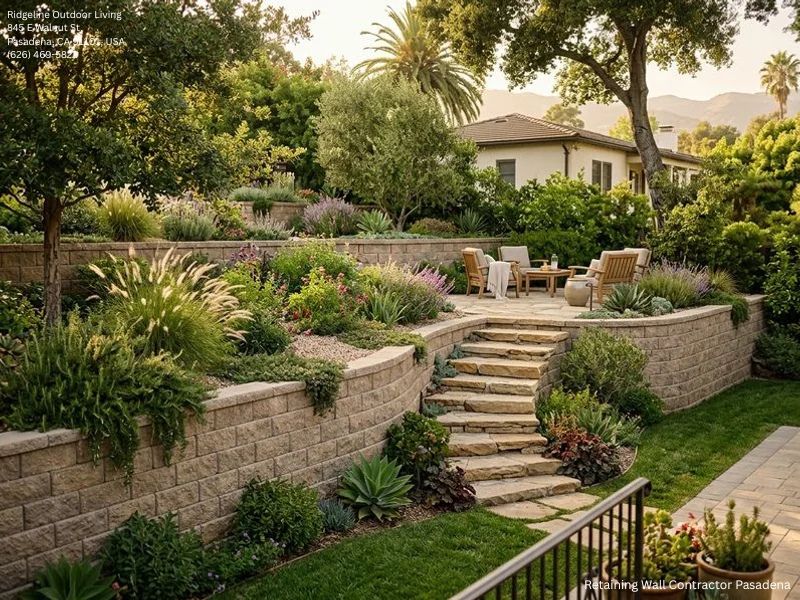
Retaining walls for hillside properties need a true subdrain with daylit outlet or a controlled tie-in. Weep holes alone are not a drainage plan. Behind every wall we build, there is a clean stone backfill column at least 12 inches thick from heel to a geotextile barrier, a perforated pipe at the base, and a path for that pipe to discharge. Walls fail more often from water pressure than from gravity loads.
With artificial turf, base compaction and underdrainage determine whether the surface smells and puddles or stays usable. We install turf with a free-draining base, sloped to a collector, and often integrate a shallow French drain at the low side. For drought-tolerant landscaping, grading and mounding set up micro-basins where plants that like a sip after storms are placed low, and plants that hate wet feet ride higher. The best drought-tolerant plants for Los Angeles yards can handle occasional winter moisture, but few thrive in chronic saturation.
Compliance, permits, and best practices
LA City and county jurisdictions have slightly different processes, but the general pattern holds. Curb cores and storm drain tie-ins require permits. On-site infiltration is encouraged but must respect setbacks from structures, property lines, and slopes. As a rule of thumb, infiltration features sit at least 10 feet from foundations and 5 feet from property lines, more on steep slopes. First flush filtration is required in many areas for new hardscape landscaping companies in Los Angeles work beyond certain thresholds. We incorporate catch basins with filter baskets or proprietary devices where they add value and meet code.
We design with erosion control in mind. On slopes, that means armoring outlets with rock, using turf reinforcement mats or coir where flows concentrate, and planting with deep-rooted species. For hillside residents, our guide on the complete guide to hillside landscaping in Los Angeles goes deeper into how drainage, retaining structures, and planting work together to prevent erosion.
What good drainage costs in LA
Costs vary with access, length, depth, and discharge complexity. For a typical residential French drain at 18 to 24 inches deep with 4 inch perforated pipe, clean stone, and fabric, expect roughly 45 to 85 dollars per linear foot. Deeper systems, hard access, hand trenching, and dense tree roots push that to 90 to 150 per foot. Add catch basins at 250 to 600 each depending on size and style, and cleanouts at 150 to 300. Curb core permits and work at the street add 1,500 to 4,000, depending on jurisdiction requirements and paving restoration.
Grading costs by area and scope. Rough regrade of a yard with skid steer access often falls in the 2 to 4 dollars per square foot range. Precision grading for patios, with base prep, can be 4 to 10 dollars per square foot. Hauling spoils off site in LA traffic adds quickly, especially during wet months when dump sites restrict loads. It is not rare to spend 1,000 to 3,000 just on trucking for a mid-size project.
These ranges reflect current labor and material prices we see across Los Angeles. They also assume we build legal, serviceable systems with professional compaction and cleanup. Bargain quotes usually omit some part of that equation.
Common mistakes we avoid
- Pitch pipe without measuring slope. Eyeballing a 1 percent fall does not work across 60 feet. We laser every run. Wrap perforated pipe in a sock and skip fabric around the gravel. In our soils, the sock clogs first. Discharge water onto a neighbor’s property, or into a planter without an overflow path. That trades one problem for a more expensive one. Put a French drain too close to a foundation without waterproofing and engineering intent. Drying clay next to a footing can cause settlement. Undersize a trench drain at a garage threshold, then ask a 4 inch French drain to bail it out in a cloudburst. Surface drains need surface capacity.
How drainage integrates with outdoor living features
Designing a beautiful yard without integrating drainage is like building a kitchen without sockets. Outdoor kitchens, pergolas, pools, and fire features need dry, stable ground. In our guide on how Ridgeline Outdoor Living creates functional outdoor living spaces, we show how the grade under a kitchen controls appliance longevity and keeps spills from pooling under cabinets. Pool decks slope gently to slot drains that whisk away splash without sending chlorinated water into planters. Fire pits sit on well-drained bases so a week of rain does not leave a soggy smoke smell when you finally light it.
When we plan patios and living spaces, we consider early whether a covered patio or a pergola fits better with water management. Pergolas allow light rain to pass through and reach plantings that can absorb it. Covered patios push runoff to edges, which requires gutters and leaders that tie into the drainage plan. Those trade-offs drive details that keep the space usable through winter and shoulder seasons. For homeowners chasing a resort-style backyard at home, these invisible moves are what make the space feel effortless year round.
Maintenance that extends system life
Even well-built systems need occasional attention. We advise clients to clean catch basin grates before major storms, especially in fall when leaves drop. Pop-up emitters should articulate freely. If they stick, a quick hose flush usually helps. Every year or two, we snake or jet mainlines through cleanouts, more often on heavily treed lots. We keep mulch pulled back a couple of inches from the top layer of a gravel trench so fines do not migrate in. On paver patios, re-sanding joints and checking low spots keeps flow moving off the surface toward the planned exits.
Vegetation matters too. In drought, we reduce irrigation in areas near French drains. Chronic summer irrigation over a perforated line can saturate roots, particularly in clay. The whole point is to manage stormwater, not to create an unintended wet zone in August.
When to call a professional
Some drainage issues are straightforward. You can redirect a downspout to a lawn with a solid leader. You can add a shallow swale that moves water 20 feet to a pop-up. Others involve structure and code. If you see moisture in a crawlspace, settlement cracks near doors, hillside slumping, or a retaining wall that leaks fines, bring in someone who does this every week. The cost of an expert design and a clean install is smaller than the bill for structural repairs or a neighbor dispute.
Our design process starts with a site walk and a conversation about how you use the space. If you entertain often, we bias drainage away from the patio even if it means longer runs. If a driveway doubles as a play space, we protect it more aggressively from surface flow. The goal is not just dryness. It is a landscape that functions without calling attention to the invisible work under your feet.
A short homeowner checklist for smarter drainage planning
- After the next storm, walk the yard and note where water sits longer than 24 hours. Take photos. Confirm where every downspout goes. Many end in planters or at grades that tilt toward the house. Map slopes roughly with a level on a long straightedge. Look for negative pitches within 10 feet of the foundation. Check where water will go if your first choice backs up. Every low area needs a safe overflow. Before any trenching, call 811. Mark trees and agree on root protection zones.
Why French drains and grading are worth it
Drainage never becomes a bragging point at a dinner party. Yet it is the quiet framework that lets a yard do what you expect. Hardscaping features that increase property value lose their edge if water stains creep across them. The best drought tolerant plants will not save a bed that drowns in winter. Even an outdoor kitchen built to perfection sours fast if a storm turns it into an island.
When done with care, the system disappears into the landscape. Paths dry quickly. Lawns bounce back a day after a storm. Retaining walls stay plumb. A curb pop-up opens during a downpour, then sits unnoticed for the rest of the year. That is the mark of drainage done right.
If you are planning upgrades, use drainage as a backbone instead of an afterthought. Whether you are comparing paver patios vs stamped concrete, choosing between pergolas and covered patios, or pricing what hardscape construction costs in Los Angeles, bring slope and water into the conversation early. The result looks better, costs less to maintain, and holds value longer. And when the next heavy band of rain slides across the radar, you will watch the water go exactly where it should.