A good Los Angeles landscape earns its keep. It resists heat and drought, moderates stormwater when the rare downpour hits, settles into a hillside without creeping, and looks unfazed after a weekend of guests. High‑value hardscaping is the spine of that experience. It is the set of engineered surfaces and structures that turn terrain into rooms, routes, and views. When done well, the stonework fades into the background and the comfort stands out. When done poorly, cracks, puddles, and shifting steps announce themselves as soon as the first Santa Ana winds blow through.
At Ridgeline Outdoor Living, we design and build for longevity and return on investment. We work from the soil up. That means reading a site before drawing a line. In a city with pockets of expansive clay, decomposed granite, and fill from mid‑century grading, that early attention matters more than any catalog of pavers or pergolas ever will.
Where every durable landscape begins
Hardscape strength does not start with concrete strength. It starts with understanding the ground. In many Los Angeles neighborhoods, you will find a crust of decomposed granite overlying clays or silts. Move into View website canyon tracts and the backfill behind old terraces can be poorly compacted. On the coastal plain, you often see finer soils that hold water. These conditions dictate how we excavate, compact, and drain.
For patios, driveways, and walkways, the subgrade must be uniform and firm. We test soils with a dynamic cone or by proof rolling, then remove organics and topsoil. On most flat backyards, we place 4 to 8 inches of compacted Class 2 base under pavers. For vehicle loads, we increase that to 8 to 12 inches, sometimes more if the soil is weak. In hillside settings, we often include a geotextile separator between native soil and base rock to prevent pumping and migration over time. The base gets compacted in lifts to 95 percent relative compaction, verified with a nuclear gauge when the design demands it.
Drainage is interwoven at this stage, not attached at the end. A patio without a place for water to go will telegraph every storm as staining, efflorescence, and joint loss. We aim for 1 to 2 percent surface slope, and we give each surface an outlet, often to an area drain that ties into a subsurface system. On hillsides, we intercept water above walls with swales and perforated pipe, daylighting safely at the street or a dissipater. French drains are often overused as a cure‑all. They work when placed in the right soil profile, wrapped in fabric, graded at a consistent fall, and connected to a lawful discharge point. They fail when they are shallow trenches stuffed with rock that have no place to drain.
When the foundation is right, materials can do their job and look good doing it.
Designing for value that shows up in appraisals and daily life
Value in outdoor living shows up in three ways. It is visible from the curb, it is obvious during use, and it is easy to maintain. In appraisal language, permanence matters. A well‑built driveway and entry sequence almost always improve perceived value, sometimes by five figures on mid‑ to high‑end homes. Out back, patios that feel like rooms, outdoor kitchens that function like their indoor counterparts, and lighting that welcomes without glare make buyers and guests linger. Drought‑tolerant landscaping is not only smart for water and maintenance, it positions a property as modern and responsible.
We see owners get the best return when they phase work sensibly. Start with site corrections that protect the home, like drainage improvements and retaining walls that stop movement. Then build the bones of circulation and gathering - patios, walkways, steps, and driveways. Layer in planting and lighting. Add luxury elements once the fundamentals are solid. The temptation to jump straight to a fire feature or a pergola is real, but those investments show better when the grade, base, and water management are already dialed.
Patios that outlast trends
Los Angeles lends itself to paver patios. Pavers adjust to small movements without cracking, they can be permeable, and repairs are straightforward. Stamped concrete still has a place, particularly for tight budgets or monolithic looks, but the trade‑offs are real. The pattern can look tired if it is not carefully chosen, and cracking is a question of when, not if, in our climate.
Here is how we guide clients when comparing paver patios vs stamped concrete:
- Upfront cost: Stamped concrete often runs 15 to 25 dollars per square foot installed, while concrete pavers typically range from 20 to 40 dollars depending on style and site conditions. Permeable paver systems fall toward the upper end due to added base and drainage layers. Longevity and repair: Pavers win for repairability. A settled corner can be lifted and reset. A cracked concrete slab demands a patch that never quite disappears or a full replacement. Aesthetics over time: Sealed or color‑through pavers hold tone better. Stamped concrete color can fade or wear unevenly along traffic routes and at chair legs if the sealer maintenance lapses. Performance on slopes: Modular pavers allow stepped transitions and are friendlier on complex grades. Large concrete pours on slopes bring complicated formwork and cold joints that can read visually. Permeability: If reducing runoff is a goal, permeable pavers paired with an engineered base help infiltrate and slow water. Stamped concrete needs adjacent drains or wider planting beds to compensate.
We have installed timeless patios with linear plank pavers that stretch a small space and with oversized formats that feel modern around a pool. In shaded canyons, textured pavers reduce slip. Near the beach, choosing dense, salt‑resistant materials avoids edge spalling. The point is not to chase the 15 paver patio designs Los Angeles homeowners love, but to pick a pattern and color that harmonize with the home’s architecture and the light on your lot.
Outdoor kitchens that cook like the real thing
A grill island is not an outdoor kitchen. A kitchen functions end to end. It gives you prep space, heat zones, cold storage, a handwashing sink, and protected utilities. With that standard in mind, what does an outdoor kitchen cost in Los Angeles? For a simple 8 to 10 foot linear island with a quality grill, side burner, access doors, and durable cladding, expect 25,000 to 45,000 dollars. Add refrigeration, a pizza oven, a deep sink with hot water, storage, and premium stone, and a U‑shaped configuration can land in the 55,000 to 90,000 dollar range. A fully appointed, covered kitchen with integrated heaters, lighting, and a bar for eight can exceed 100,000 dollars, particularly when utility runs are long or trenching crosses tree roots that require protection.
We favor vented stainless cabinets or masonry frames with waterproofing membranes, since coastal moisture and morning marine layers work their way into everything. Counter materials matter. Porcelain slabs resist staining and heat, and they do well outdoors. Some marbles and limestones are beautiful but etch and patina quickly with citrus and wine. If you love them, use them with clear eyes.
Trends we see Los Angeles homeowners choosing now are practical more than flashy. Integrated trash pullouts, a small warming drawer to hold tortillas for taco nights, and a separate cooktop for simmering sauces are being picked over massive statement hoods. Covered patios that keep sun off the chef in August and light rain off guests in January are an upgrade that earns praise every time.
Fire features that pull people outside
Fire extends the season and anchors a seating area. Gas fire pits and linear fire tables dominate for ease and code compliance. Wood is romantic and allowed in some jurisdictions, but local restrictions and neighborly smoke concerns are real. The best layouts assume how people actually use them. If the pit sits between two chairs with a narrow gap, flames lick at knees. If the burner is oversized for the space, the slightest breeze pushes heat away. We scale the burner to the seating radius and height. A 24 to 36 inch round burner suits a 6 to 8 foot diameter seating circle. Burners should sit at or just below seat height to radiate across laps.
We set gas fire elements on proper footing, sleeve gas lines where they cross joints, and keep ignition components accessible. Clearances to structures and plants are not suggestions. Leave 10 feet of overhead clearance and at least a few feet of lateral space from combustible walls unless the product is listed for closer installation. Think through wind. In canyons, a low wall or glass windscreen earns its keep.
Hillsides, retaining walls, and the physics of staying put
Much of Los Angeles is hillside, and retaining walls are not decoration there. They are structures that hold back thousands of pounds of soil and water. Homeowners need to know the difference between a garden wall and a retaining wall. Once a wall retains over 3 to 4 feet of soil, many jurisdictions require a permit and engineered plans. That is not red tape for its own sake. The surcharge from a driveway or a slope above, the presence of expansive clay, and the potential for hydrostatic pressure all demand calculation.
We build with segmental retaining wall systems where appropriate, cast‑in‑place concrete when loads are high or space is tight, and hybrid solutions when a veneer is desired over a structural core. Geogrid reinforcement extends into the backfill, and drainage is non‑negotiable. A perforated pipe set at the heel of the wall, free‑draining gravel wrapped in fabric, and a weep path or outlet reduce pressure from trapped water. On several projects in the Hollywood Hills, the difference between a wall that leans in three years and one that stands for decades has been as simple and as critical as continued maintenance of the drain outlets. You cannot just bury performance details and hope.
For homeowners looking at The Complete Guide to Retaining Walls in Los Angeles, budgets vary widely. Small, non‑engineered decorative walls run a few hundred dollars per linear foot. Engineered walls with footings, steel, drainage, and inspections more commonly land in the 80 to 150 dollar per square foot of face area range, and complex hillside access can push higher.
Drainage that disappears until the storm arrives
Stormwater in Los Angeles is feast or famine. A year can pass with only a few light showers, then one atmospheric river tests every slope and swale on your property. Good drainage is part science, part choreography. Water wants the shortest route down. We give it predictable paths that protect structures and paving, and we make those paths easy to maintain.
Homeowners often ask how to solve common yard drainage problems without major reconstruction. Sometimes the fix is surgical. Regrade 10 feet away from the house to establish a gentle fall, add a catch basin in a depression where water lingers, and tie that to an existing downspout line that discharges legally at the curb. In heavier clay soils, an underdrain beneath a lawn relieves sogginess. In backyards boxed by neighbors, we may install a sump with a pump that sends water to the street when no gravity path exists, bearing in mind local regulations.
You do not need a storm to spot issues forming. Watch for these early warnings of trouble during irrigation and morning hose tests:
- Pooled water within 5 to 10 feet of the foundation after 24 hours Seepage stains or efflorescence lines at the base of walls, steps, or planters Mulch or fines migrating across patios after light rain, indicating unchecked sheet flow Grass that grows in stripes or patches, a sign of subsurface drainage patterns or compaction Ruts near downspouts where runoff hits bare soil before being captured
There are more signs, from soft spots next to driveways to settling along trench lines, but these five appear most often. The fix should always end with a lawful discharge. Sending water to a neighbor’s yard is not a solution.
Water wise is not sparse
Drought‑tolerant landscaping is a smart investment because it holds its look with less water and less drama. That does not mean a sea of gravel with two agaves. The best drought‑tolerant plants for Los Angeles yards are regionally adapted and layered for year‑round interest. Coast live oaks or olives can be the canopy where space allows. Manzanita and ceanothus provide structure and spring bloom. Salvia, penstemon, and yarrow carry summer color that supports pollinators. Evergreen groundcovers like Dymondia hold edges where lawns once sat.
Turf remains desirable in play areas. The artificial turf vs sod debate turns on use, texture, and heat. Quality artificial turf avoids muddy patches and reduces irrigation, but it can read warm to the touch in August and needs proper base, edging, and drainage. We excavate 4 to 6 inches, install compacted base, and add a permeable bedding layer. We include a deodorizing infill and consider subdrains where pet use is heavy. Natural sod requires irrigation but stays cooler and can be more comfortable for toddlers and dogs. A small hybrid approach works well. Keep a real lawn where you sit and play, and use artificial turf in narrow side yards that are hard to water evenly.
Driveways that lift curb appeal
Driveways are the first hardscape visitors touch. They also bear the greatest loads. The most popular driveway materials in Los Angeles remain pavers, concrete, and occasionally natural stone for short runs. Pavers shine for repairability and pattern options. Concrete delivers a clean, modern line, though joints and finishes require care to avoid a patchwork look. For curb appeal, frame a drive with a soldier course edge or a band of contrasting stone. Permeable pavers can reduce runoff, especially valuable on parcels with limited storm connection points. When space allows, a motor court doubles as a play area with a subtle color shift and a chalk‑friendly surface. Borrow from 15 driveway paving ideas to improve curb appeal, but match the house’s era. A 1920s Spanish revival reads differently than a 1960s post‑and‑beam.
On slopes, traction and water control define success. We roughen finishes appropriately and use trench drains at garage thresholds if apron slopes are steep. Maintenance is planned. We set cleanouts for any drain lines under the drive. We seal joints where the drive meets the street to keep weeds and water from eroding edges.
Lighting that flatters and protects
Outdoor lighting earns its budget at the first twilight. It invites you outside, guides guests, and extends views from inside the house. The best lighting is layered and restrained. Path lights aim down and are spaced to avoid a runway look. Step lights sit in risers where glare is blocked by treads. Moonlighting from trees gives a soft, natural wash. Warm color temperatures, typically around 2700 to 3000 Kelvin, feel inviting against stucco and stone.
Common landscape lighting mistakes that reduce curb appeal show up quickly. Fixtures mounted too high on walls cause scallops of glare. Overly cool bulbs flatten plant textures. Bright spots at the property edge annoy neighbors and erode the sense of calm. We use dimmable systems, map zones, and test at night before committing to final placements. Ten outdoor lighting ideas for Los Angeles landscapes could fill a book, but the simplest win is to light less, then adjust upward only if a path reads uncomfortable.
Water, fire, and sound
Water features return to favor when they run quietly and use water wisely. A small rill along a patio edge or a wall‑mounted scupper that drops into a narrow basin offers white noise without dominating. In luxury backyards, reflective pools and edge‑lit basins pair beautifully with linear fire features. The combination, chosen from a palette of 15 fire and water feature ideas for modern landscapes, should complement the home’s architecture. Excessive height on jets and flames looks theatrical and tires quickly. We size pumps to just meet the desired sheet of water, add debris baskets for easy cleaning, and separate lighting circuits so that flame and water can be staged or used alone.
Structures that shape space
Pergolas, arbors, and covered patios solve heat and create rooms. In Los Angeles, slatted pergolas with adjustable louvers give flexibility, while solid covers protect kitchen finishes and soft seating from morning dew. The pergolas vs covered patios question tends to resolve around how you plan to use the space from June to September. If you host daytime gatherings or cook most evenings, a covered patio with integrated fans and heaters is hard to beat. If you prioritize winter sun and a light touch, a pergola may be right. We often position a pergola over dining and leave the lounge open to the sky with a moveable shade solution.
Designing the perfect outdoor dining space is less about square footage and more about circulation. Leave 3 feet around the table for chairs to move comfortably. Place the kitchen within sight but not so close that smoke pushes across plates. If the dining area runs long, consider a second, smaller destination, perhaps a bistro pair near a fragrant hedge for coffee in the morning.
Pools and the ground around them
Pool landscapes in Los Angeles blend safety, shade, and non‑slip surfaces. Porcelain pavers set on pedestals allow for drainable, level decks that stay cooler than darker stones. A green surround can be water wise. Use narrow ribbons of drought‑tolerant turf or low plantings like thyme between steppers to soften the hardscape. Ensure fencing meets code without caging the view. We recess latches, align posts with geometry, and plant to blur the line without impeding inspection.
When designing a backyard around your swimming pool, resist overcomplication. Keep traffic clear from house to pool, give swimmers a place to drop towels, and give spectators a shaded perch with sightlines. If you plan for an outdoor shower, place it close to the house side to avoid long winter walks.
The design‑build process that protects budgets
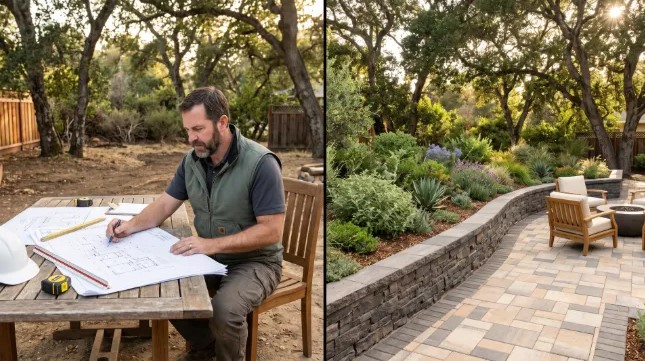
How Ridgeline Outdoor Living approaches design‑build landscaping is simple on paper and disciplined in practice. We lead with site reading and program. We place functional elements first, then we add finishes and planting. We coordinate utilities early, trench once, and backfill once. We document what we build. On hillside projects, we bring a structural engineer into layout conversations, not only into plan stamping. That saves redraws and change orders. We price with real assemblies, not allowances that evaporate when selections are made. Clients often tell us that professional landscape design saves time and money because it uncovers conflicts on paper rather than in concrete, and because a cohesive plan avoids piecemeal changes that ripple across trades.
For those interviewing firms, 10 questions to ask before hiring a landscape contractor can be distilled to a few that reveal competency. Ask how they manage drainage under patios. Ask for details on base preparation and compaction testing. Ask how they protect trees during trenching. Ask for a lighting mockup night. The answers tell you if you are talking to builders who solve problems before they appear.
Business Name: Ridgeline Outdoor Living
Address: 845 E Walnut St, Pasadena, CA 91101, United States
Phone: (626) 469-5822
Ridgeline Outdoor Living
Ridgeline Outdoor Living is a Pasadena-based landscape design-build company serving Greater Los Angeles with custom outdoor living, hardscape, and drought-tolerant landscape solutions. The company specializes in patios, retaining walls, outdoor kitchens, drainage, hillside projects, and turnkey landscape construction, handling projects from design and permitting through final build and warranty.
845 E Walnut St, Pasadena, CA 91101, USA
Business Hours:
- Monday – Saturday: 8:00 AM – 6:00 PM
- Sunday: Closed
Follow Us:
What hardscape construction costs in Los Angeles
Budgets vary with access, engineering, and taste, but some ranges help frame expectations:
- Patios: Concrete pavers at 20 to 40 dollars per square foot, higher for porcelain or large‑format slabs. Stamped concrete at 15 to 25 dollars. Natural stone set on slab at 40 to 70 dollars depending on stone and layout. Driveways: Pavers at 25 to 50 dollars per square foot due to vehicle‑rated base and edge restraints. Concrete at 18 to 35 dollars, more with decorative sawcuts and integral color. Outdoor kitchens: 25,000 to 120,000 dollars as outlined above, with utility distances and covers influencing the upper end. Retaining walls: 80 to 150 dollars per square foot of face area for engineered systems, less for small garden walls. Drainage: 75 to 150 dollars per linear foot for basic area drains tied to curb where gravity allows, more for pumps or difficult runs.
These are planning numbers, not bids. Site access, export of spoils, and jurisdictional requirements change the math. The point of an early budget is to phase work sensibly and to choose details that hold value.
Maintenance that preserves investment
High‑value hardscaping does not mean high‑maintenance. It does mean consistent, light care. Sweep polymeric joints free of constant moisture to prevent haze. Reseal select surfaces every few years if the product calls for it, particularly in high‑traffic dining zones. Clean drain grates and camera the line every few years if you live under leaf‑heavy trees. Adjust lighting as plants grow. Trim roots thoughtfully near paving. The most avoidable failures we see start with clogged drains and unaddressed irrigation leaks that undermine base material.
When to add the extras
Once the bones of circulation, grade, and drainage hold steady, the extras change how a yard lives. Ten outdoor living ideas transforming Los Angeles backyards are not fads so much as refinements. A small, covered reading nook detached from the main patio gives two households in one yard. A vertical, sculptural water wall catches light without requiring a big footprint. A pergola over a side yard transforms a forgotten path into a vine‑framed gallery. A linear fire element inset flush with a patio invites people to walk around and through, not huddle. A gravel court planted with olives turns into a place for pétanque on long evenings. Each of these costs less when planned into the initial grading and utilities rather than retrofitted later.
What not to do
Backyard renovation mistakes tend to rhyme. Don’t pour a large monolithic slab against your foundation without a joint and a clear drainage plan. Don’t place a fire pit under low limbs or too close to wood fences. Don’t choose planting that will outgrow narrow beds along paths, then complain about hedgers nicking your pavers. Don’t forget lighting control zones, then live with one switch that blasts everything. Don’t trench across a mature tree’s critical root zone without an arborist’s input. And don’t skip permits where they are required. Unpermitted retaining walls or gas lines have a way of surprising sellers and buyers later.
The throughline from soil to stone
From the first shovel in the ground to the final stainless screw on a cabinet door, the work is about respecting forces. Gravity wants to pull soil downhill. Water wants the fastest path. Heat wants to crack rigid surfaces. Plants want the right root space. People want comfort and beauty without fuss. The craft lies in arranging materials so that each force is guided and each desire is met, quietly and for a long time.
High‑value hardscaping in Los Angeles is not a shopping list of 12 backyard entertainment features every homeowner should consider. It is a sequence of wise decisions. Choose the best hardscape materials for Southern California landscapes that match your site and use. Keep water moving where it should. Support slopes honestly. Light softly. Plant intelligently. Build kitchens and patios that function as promised. Do the invisible right, and the visible will continue to delight.