Los Angeles asks landscapes to do a lot with a little. We want shade, privacy, usable outdoor rooms, and year-round beauty, yet we live with long dry spells punctuated by intense winter storms. Over two decades designing and building outdoor spaces across the basin, from the Valley’s heat to the marine layer of the Westside and the steep lots in the foothills, our team at Ridgeline has learned that truly sustainable, water-smart landscapes are not built around a single tactic. They are a system, tuned to microclimate, soil, and use. The right choices lower water bills, reduce maintenance, survive heat waves, and protect homes during downpours.
This is how we approach it, and what you can take from that process to shape a resilient property of your own.
Start with what the site tells you
Most disappointing landscapes fail at the first step. Before plant lists or paver samples, we map constraints and assets. A south-facing slope in Encino bakes by noon in August. A canyon floor in Beverly Glen funnels cold air at night. A beach-adjacent yard in Venice fights wind and reflected glare. We note sun paths, shade from neighboring structures, drainage patterns after storms, and the spots a family actually uses. We pull a soil profile at various points, because the backyard may sit on compacted fill while the side yard holds sandy loam that drains too quickly.
Lab soil testing costs a few hundred dollars and pays for itself. It tells us whether we are working with heavy clay that needs structure, or alkaline conditions that will lock up micronutrients for manzanita or citrus. It also guides irrigation design. A clay soil accepts water slowly, around 0.1 to 0.2 inches per hour, while sandy soil can take three to four times that. Water-smart design matches application to infiltration so moisture sinks where roots need it rather than running into the street.
We pair this site read with city rules. Hillside properties often sit inside Very High Fire Hazard Severity Zones. That changes plant spacing, mulch choices near structures, and ignition-resistant construction details. Some water features require backflow prevention devices. Graywater tie-ins must follow California Plumbing Code. Good design starts by acknowledging the guardrails.
Hydrozones and palettes that make sense in Los Angeles
It is tempting to plant what you love, then brute-force it with irrigation. We reverse that. Grouping plants by water need, exposure, and mature size creates hydrozones that are efficient to irrigate and simple to maintain. A tight Mediterranean palette near the curb with rosemary, rockrose, and dwarf olives might require monthly deep watering after establishment. A shaded courtyard can hold ferns, aspidistra, and clivia on a different schedule. Fruit trees form another zone altogether.
For those who want the look and performance of low-water landscapes, The Ultimate Guide to Drought-Tolerant Landscaping in Los Angeles holds up well when anchored by locally appropriate species. The Best Drought-Tolerant Plants for Los Angeles Yards usually includes toyon, coffeeberry, manzanita, and buckwheat on the native side, mixed with reliable Mediterranean performers like lavender, santolina, lomandra, westringia, and arbutus. We also lean on trees that do real work. Desert willow, palo verde, Chinese pistache, and Brisbane box give scale and filtered shade without washing a yard in leaf litter all summer. On the coast, Catalina cherry and island oak handle salt air and wind.
We do not chase color with thirsty annuals. Instead, we stagger bloom and texture. Ceanothus turns electric in February and March. Salvia clevelandii hums with pollinators by June. Muhlenbergia capillaris throws pink clouds in fall. Design the chromatic rhythm and you will not miss petunias in July.
A word on lawns. Grass is water hungry in Los Angeles if you try to run cool-season varieties like fescue. If you must have a lawn, hybrid Bermudagrass or zoysia on a properly prepared base can drop irrigation needs by a third. Most families realize they do not need 600 square feet of turf, only 150 square feet of kid space. Right-sizing a lawn is often the single largest water savings on a site.
Drip, delivery rates, and smart control
The typical yard we retrofit has spray zones running 12 to 15 minutes three times a week on fixed schedules, regardless of weather or shade. That creates shallow roots, fungal issues, and high runoff. We replace that with matched-precipitation rotors in lawn areas and inline drip for planting beds. Two details matter more than the hardware catalog.
First, pressure and filtration. Inline drip wants 25 to 30 psi and clean water at the emitter. We specify pressure-regulating valves, flush points at line ends, and 150 mesh filters so the systems stay consistent for years. Second, run times tied to soil type and emitter spacing. On a clay soil with 0.6 gallon per hour inline emitters spaced 12 inches, you may only need 30 to 40 minutes once or twice a week in the peak of summer to recharge the root zone to 6 to 8 inches. On sandy loam, the same plants might need shorter, more frequent pulses to avoid percolating past the roots.
Smart controllers earn their keep. A WaterSense-labeled controller with weather-based programming and flow sensing can cut outdoor use by 20 to 40 percent compared to conventional timers. We prefer models that allow separate soaking cycles, as that helps with infiltration on tight soils, and that integrate with a master valve and flow meter to detect breaks. Set it up once, then fine-tune per zone as plants mature.
We hear a lot about subsurface drip for lawns. It can work, but only on clean soil with minimal roots and a top-notch filtration regime. In gopher-prone areas, the maintenance burden outweighs the benefit. For most LA lawns, high-efficiency nozzles with head-to-head coverage remain the sweet spot.
Soil health as water strategy
We measure water savings in the soil, not at the spigot. Healthy soil holds moisture like a sponge, letting plants stretch between irrigations. We build that capacity with compost, mulch, and living roots.
On a new build, we rip compacted subgrade 8 to 12 inches where feasible, then incorporate two to three inches of fine compost into the top six inches. That is about 0.5 to 0.75 cubic yards per 100 square feet. Where tree roots are present, we switch to surface applications to avoid damage. We also inoculate select beds with mycorrhizal fungi, particularly when planting natives. Anecdotally, we see higher first-summer survival and better drought resilience when those relationships establish.
Mulch is nonnegotiable. Three inches of shredded wood mulch, kept pulled back from plant crowns, can cut evaporation by half. In fire zones we use gravel mulch or composted bark within the first five feet of structures, then transition to wood chips beyond. Keep irrigation buried under mulch to reduce crusting and wind loss.
Business Name: Ridgeline Outdoor Living
Address: 845 E Walnut St, Pasadena, CA 91101, United States
Phone: (626) 469-5822
Ridgeline Outdoor Living
Ridgeline Outdoor Living is a Pasadena-based landscape design-build company serving Greater Los Angeles with custom outdoor living, hardscape, and drought-tolerant landscape solutions. The company specializes in patios, retaining walls, outdoor kitchens, drainage, hillside projects, and turnkey landscape construction, handling projects from design and permitting through final build and warranty.
845 E Walnut St, Pasadena, CA 91101, USA
Business Hours:
- Monday – Saturday: 8:00 AM – 6:00 PM
- Sunday: Closed
Follow Us:
Remember that soil improvement does not offset bad drainage. If you have ponding against a foundation after storms, build outlets for water rather than counting on compost to fix grade.
Permeable hardscape, done for looks and function
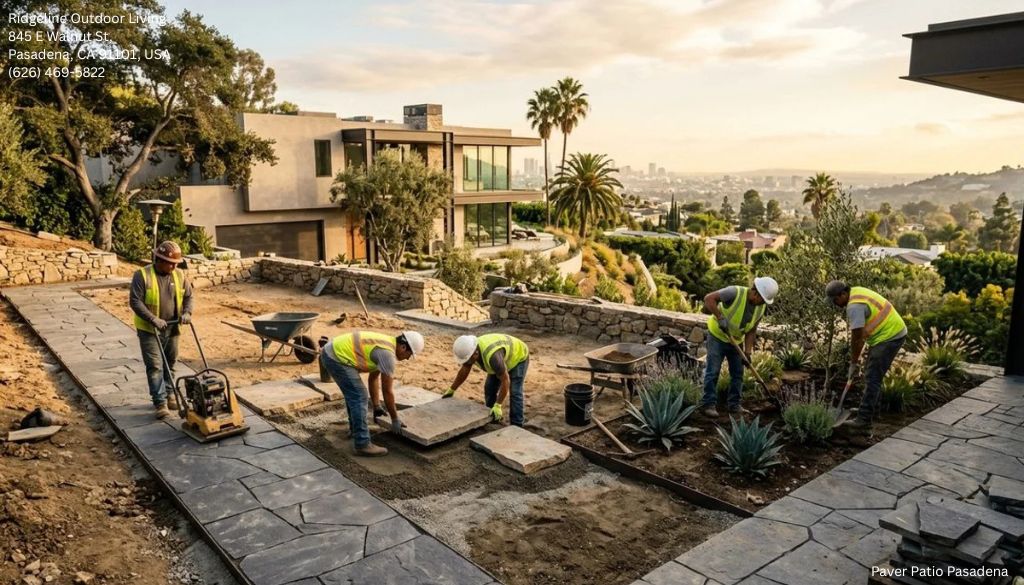
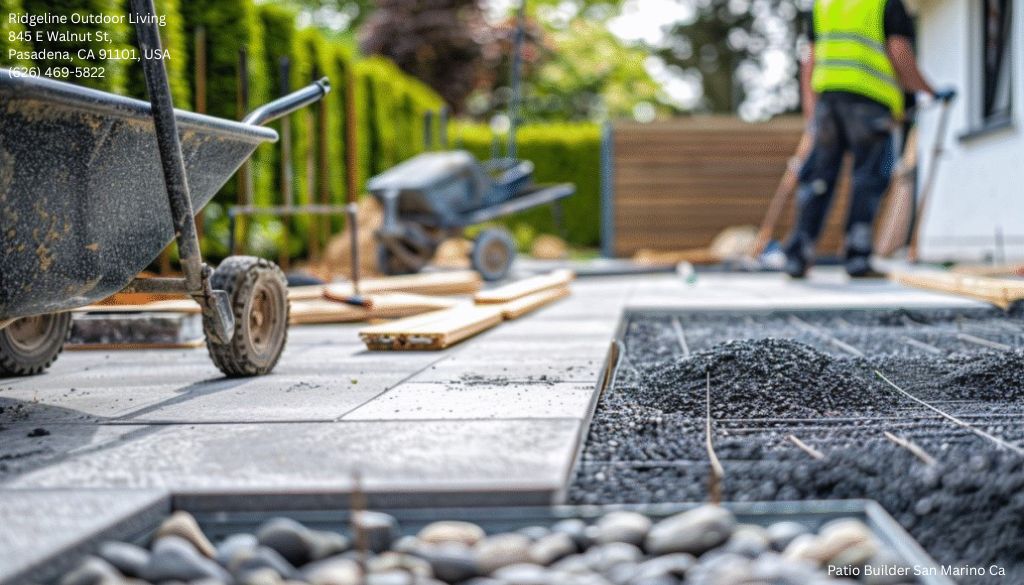
Los Angeles homes crave outdoor rooms. The choice of paving affects water behavior and thermal comfort for decades. We favor permeable paver assemblies in gathering areas, with open joints and an engineered base that stores and slowly releases stormwater. Done right, these patios look identical to traditional installations, yet let tens of thousands of gallons per year infiltrate on site rather than race to the gutter. The technique pairs especially well with 15 Paver Patio Designs Los Angeles Homeowners Love, like herringbone paths that lead from kitchen to garden or large-format pavers separated by groundcover strips in a modern yard.
If you are comparing Paver Patios vs Stamped Concrete: Pros and Cons, understand that pavers allow sectional repairs, resist cracking from tree roots or minor settlement, and can be detailed to meet ADA thresholds cleanly. Stamped concrete demands more frequent sealing to keep color and holds heat longer on August afternoons. The upfront cost of permeable pavers in Los Angeles typically runs in the mid to high twenties per square foot for straightforward work and can climb with curves, lighting, or structural requirements. Conventional concrete may pencil lower, but future-proofing drainage often turns the math back in favor of pavers.
Driveways deserve the same treatment. The Most Popular Driveway Materials in Los Angeles have shifted toward textured concrete, concrete with decorative bands, and interlocking pavers. If you cannot go fully permeable, consider permeable aprons or strips between tire tracks to lower runoff.
On hillside lots, hardscape intersects with structure. Retaining Walls for Hillside Properties: What Homeowners Need to Know starts with engineering and drainage. Weep holes are not a luxury. Behind any retaining wall, we specify a free-draining gravel backfill with a perforated drain pipe wrapped in fabric to prevent fines from clogging the system. Tie those drains to safe discharge points. Think about the January storm while you are still enjoying September sunsets.
Drainage that protects your property
A water-smart landscape is not just about reduced irrigation. It safely handles the water we do get. French Drains Explained: Protecting Your Property From Water Damage boils down to three consistent details. You need a trench lined with nonwoven geotextile, a perforated pipe set at the invert of the trench with appropriate slope, and clean 3/4 inch crushed rock filling the voids. Do not wrap the pipe in a fabric sock and skip the wider fabric liner. That traps fines at the pipe. The fabric goes against the soil to keep the entire trench clean.
We integrate French drains with swales that carry water along gentle grades to rain gardens or dry wells. On small city lots, dry wells are a workhorse. A properly sized dry well with inspection port can infiltrate roof runoff from a typical 2,000 square foot home over several days. The Complete Guide to Hillside Landscaping in Los Angeles must also include surface water controls, like curb cuts at the top of slopes, level spreaders that reduce velocity, and armored outlets so a downspout does not bore a hole in a slope.
Homeowners often do not know they have a drainage problem until plants rot, patios heave, or musty odors creep into a garage. If you see algae on concrete, mulch lines washed downhill, or puddles that linger more than 48 hours after a storm, those are 10 Signs Your Yard Needs Better Drainage. We would rather place one discreet catch basin now than rebuild a lifting walkway in two years.
Capture what you can reuse
Rain is too valuable to waste. Even in a low year, a 1,000 square foot roof in Los Angeles can shed more than 10,000 gallons. We size cisterns to match use patterns and available space. Slimline tanks along side yards often range from 300 to 800 gallons. Underground tanks serve larger properties, but they require access for excavation and maintenance. Tie rainwater into drip zones for trees and deep-rooted shrubs, and you stretch storage between storms.
Graywater from laundry is another resource. A laundry-to-landscape system that sends wash water to mulch basins around ornamentals or fruit trees is legal under California’s simple permit exemption if built to code. Avoid fats, bleach, and harsh softeners. We do not run graywater through drip emitters. Instead, we distribute it through branched lines into mulch basins, and we keep it subsurface to avoid human contact. Used wisely, graywater can supply a significant portion of a backyard orchard’s needs.
Turf choices with eyes open
Artificial turf has evolved. It can solve shade or wear issues where grass will not thrive. It also gets hot, often 20 to 40 degrees warmer than air temperature in full sun, and it is not permeable in the way a planted area is. In high-use dog runs, modern permeable backings paired with a well-designed base and deodorizing infill can manage odors. For play spaces or small putting greens, it can save water. The tradeoffs are heat, end-of-life disposal, and microplastic concerns.
Sod, on the other hand, offers cooling through evapotranspiration and a living surface. It needs water and mowing. Warm-season sod varieties, modern controllers, and good soil build can bring use down to a reasonable level. Artificial Turf vs Sod: What’s Best for Los Angeles Homes? Depends on how you use the space. One client in Sherman Oaks split the difference. A 300 square foot shade-dappled artificial turf play strip runs along the side yard where the sun never breaks through. A 200 square foot real lawn in the back, bordered by shade trees and tied to a weather-based timer, gives them that cool underfoot feel for summer gatherings. They cut outdoor water use by half compared to the previous wall-to-wall fescue.
Here is a quick comparison drawn from recent projects.
- Artificial turf - zero irrigation, high heat in sun, limited habitat value, good for heavy wear or deep shade Warm-season sod - moderate irrigation, cools air, seasonal dormancy in winter, better habitat value Hybrid approach - smallest area possible of real turf where feet actually touch down, artificial in utility zones No-turf design - gravel, groundcovers like dymondia or kurapia, and pavers for paths and play, lowest water Budget lens - quality artificial installed correctly often matches or exceeds the five-year cost of a small, efficient live lawn
Shade, structures, and microclimates
Thoughtful shade reduces water demand without touching a valve. Trees are the first tool. Deciduous canopies on the west side of a yard cut heat gain in summer yet allow winter light. Evergreen screens placed for privacy also buffer winds that desiccate foliage. Structures come next. Pergolas vs Covered Patios: Which Is Right for Your Home? Depends on exposure and use. A pergola with adjustable louvers lets you tune sun angles over a dining terrace. A covered patio with a solid roof is worth it over an outdoor kitchen to protect finishes and reduce radiant heat on hard surfaces. For blinding afternoon glare, vines on horizontal cables can be a subtle fix. We often plant grape or wisteria on a steel frame to cast patterned shade without trapping heat.
If entertaining is part of your vision, 10 Outdoor Living Ideas Transforming Los Angeles Backyards now lean heavily on spaces that are useful without waste. Think a compact bar with an undercounter fridge rather than a second full kitchen, a built-in bench with storage rather than a sprawling sectional that bakes in the sun, and a small water wall or rill instead of a large fountain. The trick is to stage experiences in cool zones. A dining area under filtered shade, a lounge around a fire feature with a wind break, and a morning coffee nook near the garden are better than any singular trophy element.
Fire and water features with restraint
Fire pits and water features still have a place in water-smart design, but we refine how they work. For 12 Backyard Fire Pit Ideas for Entertaining Year-Round, consider linear burners set at the edge of a bench, or a low circular pit with a narrow lava rock bed that radiates heat without roaring flames. Natural gas connections with electronic ignition reduce fuel waste compared to portable propane. Check local restrictions on wood burning. Many LA neighborhoods limit it for air quality, and embers are never a friend on a hillside.
With water features, circulation, not volume, does the work. A narrow rill that returns to a concealed reservoir uses much less water than a broad, shallow pool. Subsurface basins reduce evaporation and discourage algae. For the sound of water without high use, sheet falls with aeration built into the baffle produce a clean tone in a compact footprint. 12 Water Feature Ideas for Luxury Los Angeles Backyards often highlight sculptural elements. We pick those that can be run on timers, tied to smart controls, and serviced by a dedicated filter loop for clarity.
Lighting that respects night and saves power
Outdoor lighting sets mood and extends use of a yard, but it can waste power and disturb wildlife if handled loosely. We specify low-voltage LED systems with warm color temperatures around 2700 to 3000 Kelvin to keep a residential feel. Downlights concealed in trees or structures avoid glare and light trespass. Shielded path lights placed at wider intervals than you think will look more elegant than a runway. With 10 Outdoor Lighting Ideas for Los Angeles Landscapes, we routinely recommend integrated step lights for safety, subtle grazing on textured walls, and tiny indicator lights at grade to outline transitions. Avoid 10 Outdoor Lighting Mistakes That Reduce Curb Appeal, such as overlighting facades, bright uplights on bedroom windows, or cool-white fixtures that flatten materials.
Smart transformers that dim zones, set schedules, and tie into home systems save energy. LED lamps sip power and last for years. Use that efficiency to light smarter, not just more.
Materials and sourcing with a lighter touch
Water-smart thinking dovetails with material choices. Permeable aggregates for base courses, locally quarried stone, and high-albedo pavers all reduce the thermal load and runoff. We favor sustainably harvested wood for shade structures and benches, and powder-coated metal that resists coastal corrosion. In decks, modified wood and composites have improved performance, but surface temperature matters. Test samples in your sun before you commit.
Plants sourced from reputable, regionally adapted growers show up healthier and hold their shape in the landscape. We avoid bringing in species that invite pests already advancing across Southern California. That humility saves water and heartache.
Maintenance that preserves the intent
Even the best design needs stewardship. We set our clients up with a maintenance plan that protects water savings.
Irrigation audits every spring catch broken emitters, crushed lines, and controller drift. Pruning should favor structure and air flow, not shearing plants into water-greedy pom-poms. Replenish mulch annually to maintain the three-inch blanket. Feed with compost and slow-release, low-salt fertilizers in the right seasons for each plant, not a one-size-fits-all schedule. For lawns, raise mower blades in summer to shade crowns and reduce evaporation.
We also plan for growth. A 5-gallon manzanita turns into a 6-foot shrub. Give it the room from day one. Crowded plants fight and both demand more water.
Budgeting and where to invest
Costs vary by site, but some ranges help you plan. Retrofitting existing planting beds to drip and adding a smart controller commonly falls between 6 and 12 dollars per square foot, depending on access and plant density. Permeable paver patios, as noted, often land in the mid to high twenties per square foot for straightforward layouts. High-efficiency lighting with a smart transformer typically starts around 3,500 dollars for small yards and rises with complexity. A modest cistern system with first-flush diverter and pump can run from 4,000 to 12,000 dollars, depending on storage and tie-ins.
Clients sometimes ask, How Much Does an Outdoor Kitchen Cost in Los landscaping guides Angeles? The honest answer is that a simple grill island with utilities nearby might start in the mid-teens, while a fully equipped, covered kitchen with appliances and finishes climbs quickly. From a water-smart perspective, the better question is what you will use regularly. Right-size counters, pick efficient appliances, and protect them with a roof so they last. That approach supports sustainability as much as any plant choice.
If you measure returns, water reductions of 30 to 60 percent are realistic on properties coming off conventional spray irrigation and large lawns. Property value increases when outdoor spaces are both functional and well detailed, aligning with 10 Hardscaping Features That Increase Property Value and 12 Outdoor Living Features That Add the Most Value. That long arc of payback is steadier than chasing rebates alone.
Two snapshots from the field
A Brentwood courtyard, 1,800 square feet, sat between a midcentury home and a detached studio. It baked, and the owners avoided it by noon. We replaced a cracked slab with a permeable grid of 24 inch pavers and kurapia in the joints, planted two arbutus for canopy, and added a narrow rill along the studio wall feeding a subsurface basin. Drip on pressure-regulated valves, a WaterSense controller, and three inches of mulch rounded it out. Power consumption for lighting stayed below 120 watts by using warm LEDs and precise placement. In the first summer, the homeowners cut irrigation by 48 percent compared to the prior spray system, and the courtyard became the main dining room nine months of the year.
In Mount Washington, a steep, 8,000 square foot lot shed water across compacted dirt, gouging ruts. We built terraced retaining walls with proper subdrains, set swales behind each terrace, and tied roof downspouts to a 1,500 gallon cistern. Planting focused on native sages, buckwheats, and toyon, with lomandra and westringia as evergreen anchors. The city’s storms this past winter left no rills, and the cistern supplied two deep irrigations to the slope plantings between rains. Maintenance now centers on seasonal pruning and mulch top-ups rather than erosion repair.
A homeowner’s quick-start checklist
If you are ready to act, here is the order we give clients who want the biggest water-smart wins with the least disruption.
- Audit irrigation - fix leaks, regulate pressure, and swap to smart control before anything else Reduce or right-size lawn - convert outer rings to drought-tolerant beds and keep usable turf only where feet land Add mulch and amend soil - three inches of mulch and targeted composting improve moisture retention immediately Rebuild one outdoor room with permeable paving - set the template for future phases and improve drainage today Address downspouts and simple drains - keep water away from foundations and put it to work in planting zones
The Ridgeline process, briefly
How Ridgeline Outdoor Living Approaches Design-Build Landscaping is iterative. We begin with the reality of your site and goals, then we build a concept that balances architecture with ecology. Our team details grading for infiltration, sizes irrigation to soil, and chooses plants that will still look composed on day one thousand. We coordinate utilities early so an outdoor kitchen or fire feature does not force compromises to trees or drainage later. We stage construction to protect soils and roots rather than compact them, and we train homeowners or maintenance crews to keep systems tuned. How Ridgeline Outdoor Living Designs Stunning Outdoor Spaces, and how Ridgeline Outdoor Living Creates Functional Outdoor Living Spaces, both rely on top landscaping companies Pasadena that same respect for water as a resource and a force.
A water-smart Los Angeles landscape does more than save. It makes a yard feel calm on the hottest day, carries storms without drama, and ages into its setting. Get the bones right, and the rest becomes easier than you expect.